
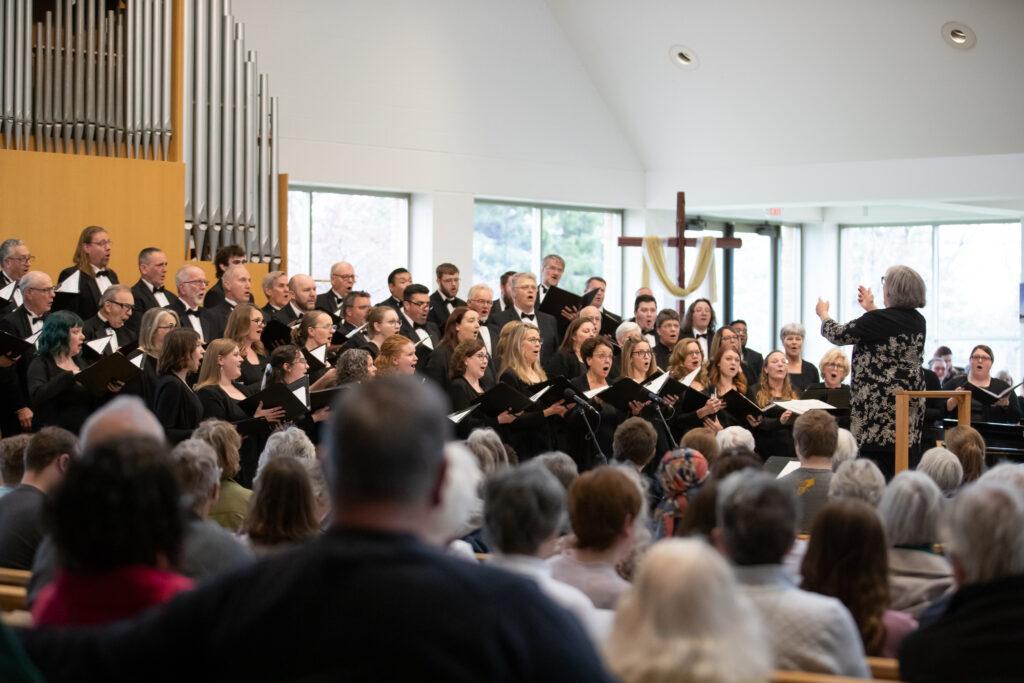
Great River Chorale, a 60-voice adult community choir based in Saint Cloud, Minnesota, was founded in 2001 and celebrated its 25th anniversary in 2026. Choir members live in communities across Central Minnesota and range in age from 23 to 78. Great River Chorale rehearses weekly and presents an annual concert series in Central Minnesota. Since 2013 the ensemble has been the principal choral partner of the St. Cloud Symphony Orchestra with which it has performed the Mozart Requiem, Faure Requiem, Beethoven Symphony No. 9 and Choral Fantasy, Borodin Polovtsian Dances, Ravel Daphnis et Chloé, and Holst The Planets, among other masterworks.
Great River Chorale regularly collaborates with local and regional guest artists such as the St. Cloud String Quartet, CSB/SJU Chamber Choir, Minneapolis Guitar Quartet, and others, and has commissioned new music from Minnesota composers including René Clausen, David Dickau, Timothy Takach, and Laura Caviani. Minnesota Public Radio selected the choir for MPR’s “Taste of the Holidays” CD featuring the state’s best regional ensembles in 2019, 2017, 2015 and 2013. Great River Chorale was the only choir outside the Twin Cities metro area selected to perform virtually in Chorus America’s 2021 National Conference, and was one of ten choirs to headline Minnesota’s Northern Voice Festival in 2015. In fall 2024 Great River Chorale started the GRC Treble Choir for adult treble voice singers in Central Minnesota.
Great River Chorale’s past artistic directors include founder Dr. David Scholz (2001 – 2006), Dr. Lee Nelson (2006 – 09), Erick Lichte (2009 – 10), Dr. Matthew Ferrell (interim director 2011 – 12), and Dr. Mary Kay Geston (2010 – 11, 2012 – 2026). We are pleased to welcome Dr. Brett Robison as Great River Chorale’s artistic and executive director effective June 2026.
Great River Chorale Mission, Values & Vision
Mission – To enrich the community through choral excellence
Values – To inspire connection, community and learning through choral music
Vision – To foster a lifelong appreciation of the choral art
Great River Chorale does not discriminate on the basis of race, color, creed,
gender, gender expression, sexual orientation, age, national origin or ancestry,
disability, marital status, status in regard to public assistance, military status, or any other classification protected by federal, state, or local law, in any of its activities or operations.